
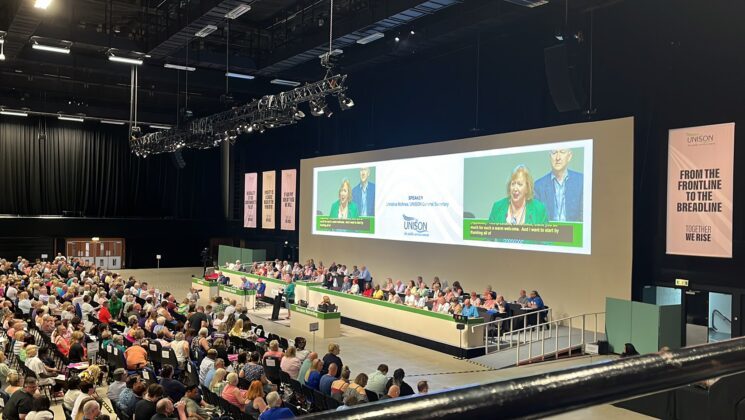
National Delegate Conference is the sovereign democratic decision-making body which sets the direction and priorities of UNISON. Branches from across regions and sectors (or ‘Service Groups’ in UNISON lingo) submit motions which call on the National Executive Council (NEC) to act over the issues affecting their members. UWE UNISON sent two of us to conference to represent the branch, and here is what we got up to.
Motions
We voted on a range of motions to establish UNISON’s campaigning priorities for the year.
We were delighted to have passed the motion which was raised by UNISON’s elected LGBT+ Committee, calling on the NEC to continue its efforts to support trans workers’ rights and campaign to reject the EHRC guidance.
Another motion, passed with a degree of frustration at the NEC’s perceived inertia, reiterated that the union should campaign for a massive bailout of public services, including universities. The new policy posits that the bailout should be funded by a tax on corporations and the super wealthy, an international tax on speculative financial transactions, a Land Value Tax to capture the value of and increases in the value of land which currently only accrue to landowners.
Other passed motions included those concerning issues such as bringing agency workers into the fold, redoubling environmental activism, campaigning for migrant workers’ rights, countering the far right, supporting Palestinian rights, implementing the ‘Organise to Win’ strategy, and increasing the participation of low paid women within the union. We will share this year’s full decision book once it is published by UNISON.
Unfortunately, the motion on Higher Education was not prioritised highly enough by regions to be discussed, despite our efforts to reprioritise the motion. However, UNISON’s Higher Education campaigns will be conducted by another body, the Higher Education Service Group Executive. You can find out more about their work here and here.
Fringe events
We attended some fringe events which occurred during lunchtimes and evenings, to network and find out more about what’s going on across the union:
Higher Education in Crisis. We heard from our General Secretary Andrea Egan and campaigners from across the sector including from the notorious University of Essex dispute. The participants from across the room told near-identical stories of endless restructures, campus closures, and poor excuses from wealthy university managers who refuse to call on the government for an alternative funding model. One of UNISON’s Higher Education Service Group member said that we can give them feedback about the ‘Fund Our Future’ campaign, and give them any ideas about how to progress. You can do so by emailing education@unison.org.uk.
Green UNISON. Chaired by environmentalist and broadcaster Tom Heap, this panel event included expert speakers including an environmental economist, a lawyer, and UNISON’s Vice-President who has been spearheading the union’s environmental activism. Unfortunately, it was focused more on technical and national questions rather than how we can organise to combat climate change as members and branches, and we gave this feedback to the organisers. However, if you are interested in getting involved in climate activism at UWE, please come along to our organising workshop which you can find the details of here.
Labour Link. The Labour Link is the part of the union which maintains relationships with and seeks to influence the Labour Party, and the meeting was advertised as having Labour MPs present. Given that UNISON’s affiliation with Labour is increasingly questioned by members, we went along to see what they would say. When we arrived, we were told that not a single Labour MP was available because of the By-Election. We’ll let you draw your own conclusions.
Big Tech in Public Services. We heard from tech justice campaigners from Foxglove, Palantir Out of the NHS, and the TUC. Big Tech algorithms are moving fast through our public services – extracting profit, burning through water and energy, and leaving workers and communities out of the conversation. Given that UWE’s recently published AI strategy doesn’t even mention sustainability, we will certainly be responding, and you can email our Environmental Officer at Tom.Carter@uwe.ac.uk to get involved.
Keynote speakers
A few high-profile speakers addressed conference:
Andrea Egan, UNISON’s General Secretary. Andrea spoke of the need for a firmer line with Labour because they have too long taken our money and support for granted. She called for massive public investment and public ownership due to democratic oversight rather than the unaccountable profiteering which has taken hold across what used to be the public sector. She argued that while the Employment Rights Act 2025 is a humongous win for which UNISON members can be proud, it does not go anywhere far enough and the government has catastrophically failed by victimising migrant workers, trans people, and has abandoned the working class. She concluded by celebrating the implementation of UNISON’s ‘Organising to Win’ strategy which has accelerated our wins across the country and has turned us into a fighting union rather than remaining subservient to Labour.
Shaher Saed, General Secretary of the Palestinian General Federation of Trade Unions. Shaher recounted the lived experience of genocide, expulsion and human rights abuses in Gaza and the West Bank. The decimation of Gaza’s economy has meant that £346m is lost per month from the wages which were being paid before 2024. He welcomed solidarity from the global trade union movement and called on British workers to ensure that our money is not being used to fund Palestinian oppression. In his words, “there is no decent work under occupation, no social justice under bombardment, starvation, and siege. And the Palestinian workers cannot build a better future when their homes are being demolished, lands confiscated and our people prevented from work.” Despite that, he said, the Palestinian resolve will not fall, and they will not abandon their lands.